Mondial : les études d’Impact Recorder montrent que la hauteur de chute des pommes de terre ne doit pas dépasser 15 cm.

Points clés à retenir
- 15 cm is the maximum drop height advised in both studies
- 100 g impact marks the start of major potato bruise risk
- 41.2 damage index on steel versus 0.4 on bulk potatoes
- 298 million dollars a year is the US bruise cost estimate
Pourquoi cela compte
- Pour les agriculteurs
- Plan an impact recorder run through harvester, trailer and store loader this season and lower or pad every drop above 15 cm
- Pour les processeurs
- Check intake hoppers and grading lines with an impact recorder and cover steel surfaces where tubers land
- Pour les fournisseurs
- Offer damage audits with impact recorders as a service, combined with padding and boom height adjustments
Résumé en 60 secondes
Drop height is the single easiest machinery setting to measure and fix, and several studies now point to about 15 cm as the ceiling. Tuber-shaped impact sensors record each knock in g, and the accepted scale puts real bruise danger from about 100 g and visible damage above 375 g. In Idaho tests of packed potatoes, boxes hitting concrete produced about 360 g at the bottom layer, against 124 g on a wooden pallet. Polish engineers found potatoes landing on steel scored a damage index of 41.2, compared with 0.4 when they fell onto other potatoes. An older Idaho bulletin estimates that bruising costs American growers at least 298 million dollars a year and advises conveyor speeds of at least 100 feet per minute. Harvest crews, store loaders and packhouses gain most from an audit. The Idaho box study concerned packaging, not field harvesters, so field thresholds may differ.
Potato bruising is estimated to cost the US potato industry at least $298 million a year, according to a University of Idaho bulletin on bruise prevention. The bulletin warns against drops greater than 6 inches, or about 15 cm. Much of that damage happens at transfer points on harvesters, trailers, piling equipment and grading lines.
An impact recording device is an electronic sensor shaped like a tuber. It travels with the crop and logs the peak acceleration of each impact in g. Researchers use common thresholds, first set out in 1992. Impacts below 50 g carry low bruise risk. Impacts between 100 and 375 g carry major bruise potential. Above 375 g, visible damage is likely.
What the recorders found
A University of Idaho team used such a device to test packed potatoes. The study appeared in the American Journal of Potato Research in April 2024. Peak accelerations in boxes ranged from 37 to 446 g. The bottom of a box dropped onto concrete or a plastic slip sheet reached about 360 g. On a wooden pallet, the same position reached 124 g. The authors concluded that drop heights need to be below 15 cm.
En semaine. Désabonnement en un clic.
A Polish team from the Warsaw University of Life Sciences tested drops from 0.30 to 1.00 m. The study was published in the journal Applied Sciences in January 2025. It compared four surfaces. The damage index was 0.4 on bulk potatoes and 20.1 on a rod conveyor. It rose to 37.1 on concrete and 41.2 on steel. Damage also differed by variety: 21.0% for Saturna and 28.4% for Hermes.
Settings that reduce impacts
The Idaho bulletin gives several machinery rules. Conveyors should run no slower than 100 feet per minute when loaded. Blades should be no longer than 18 inches. The bulletin advises harvesting only when pulp temperatures are 45°F to 65°F, or 7–18°C. It names 50°F to 60°F, or 10–16°C, as best. Vines should be killed 14 to 21 days before harvest.
Pourquoi cela compte
Bruises often appear only days later, when the crop is already in store or at the packer. A damage audit with an impact recorder shows which transfer point causes the hardest knocks.
The fixes are often cheap. Growers can lower a boom, add padding or keep conveyors full. The Polish data show that potatoes falling onto other potatoes suffer far less than those hitting steel.
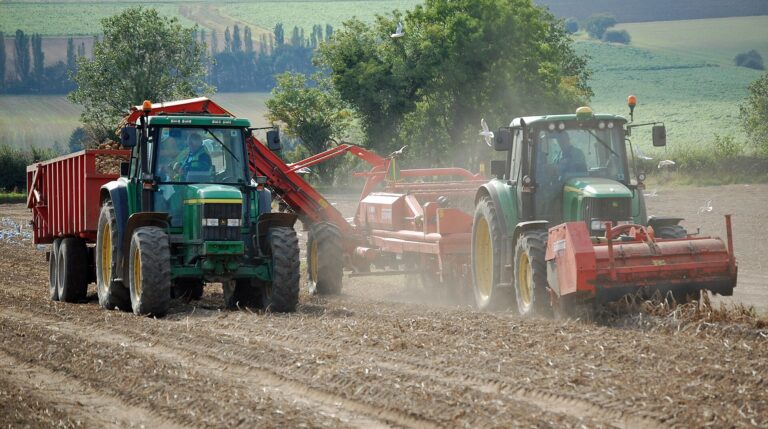
Photo: Potato harvest near Bonby, North Lincolnshire, England (illustrative). David Wright / Wikimedia Commons, CC BY 2.0
Résumé mondial sur la pomme de terre
Les cinq principales actualités, les prix, les alertes sanitaires et les événements. En semaine, le matin, sans publicité.
Références
- University of Idaho — Preventing Potato Bruise Damage (BUL 725, revised) — https://idahopotato.com/uploads/media/intl-best-practices-PreventingPotatoBruiseDamage.pdf
- Hendricks, Olsen, Thornton, Hatzenbuehler — Use of an Impact Recording Device to Determine the Risk of Bruising in Packaged Potatoes, American Journal of Potato Research (3 Apr 2024) — https://link.springer.com/article/10.1007/s12230-024-09952-8
- Sypuła et al. — Prediction of Tuber Damage from Harvesting and Processing Machine Working Units Based on the Recording of Impact Parameters, Applied Sciences 15(3):1161 (24 Jan 2025) — https://www.mdpi.com/2076-3417/15/3/1161
Lien dans ce matériel
- Pays
- Monde
- Aux technologies
- impact recording device; electronic tuber; conveyor padding
LIRE EGALEMENT

Russie : Le salon des machines agricoles AGROSALON 2026 ouvre ses portes à Moscou du 6 au 9 octobre.
Réglages de séparation sur une arracheuse de pommes de terre : comment les toiles et l’agitation protègent la récolte.