
À l'échelle mondiale : le psylle de la pomme de terre se développe de façon optimale à environ 27 °C et peut traverser la barrière des puces zébrées en quelques heures.
Points clés à retenir
- 27°C is the optimum for potato psyllid development
- 6 hours is enough for one psyllid to infect a plant
- 3 weeks usually pass before zebra chip symptoms show
- 2 uses per season is the limit for one mode of action
Pourquoi cela compte
- Pour les agriculteurs
- Installez des pièges collants jaunes en bordure de champ dès le début de la saison et planifiez les traitements anti-psylles de manière à ce qu'aucun mode d'action ne soit utilisé plus de deux fois.
- Pour les processeurs
- Prévoir des contrôles histologiques sur les échantillons de frites et de chips provenant des régions à haut risque, car les tubercules peuvent paraître sains à la récolte et présenter des symptômes ultérieurement.
- Pour les commerçants
- Vérifiez le statut des puces zébrées des régions d'origine avant de passer commande de lots de pommes de terre ou de semences provenant de zones chaudes.
- Pour les fournisseurs
- Build psyllid programmes around rotation partners and monitoring services rather than calendar sprays of one insecticide class
Résumé en 60 secondes
Zebra chip is a vector problem first: every commercial potato cultivar is susceptible, so the grower wins or loses on control of the potato psyllid. The insect does best around 27°C and can turn over a generation in under a month in warm weather. A single adult can transmit the bacterium in about six hours of feeding, a group of twenty in one hour, yet tuber symptoms usually take some three weeks to appear. Extension sources put possible losses above 85%, and even total. Advice from the Pacific Northwest is to monitor with yellow sticky cards and to use any one mode of action no more than twice a season. A 2024 scientific review warns that the heavy reliance on insecticides cannot last, given resistance and pressure on beneficial insects. Figures on infection speed come from a single Utah fact sheet, and local psyllid types may behave differently.
Zebra chip is a bacterial disease of potato. It is caused by Candidatus Liberibacter solanacearum, which the potato psyllid carries from plant to plant. Chips and fries from infected tubers show dark stripes that become more visible with frying. Such tubers are commercially unacceptable, according to a 2015 review in the American Journal of Potato Research.
The review reported the disease in the United States, Mexico, Central America and New Zealand. All commercial potato cultivars are susceptible. So control of the psyllid is the only effective way to manage the disease, the author wrote.
Temperature drives the vector
The psyllid develops best at 27°C, according to a University of Florida extension fact sheet. Temperatures above 35°C reduce egg laying, hatching and survival. Temperatures at or below 17°C may slow infection in potato. A Pacific Northwest extension bulletin gives a similar picture. The insect can complete a generation in less than a month at 75–80°F, or about 24–27°C.
En semaine. Désabonnement en un clic.
Fast transmission, slow symptoms
Infection can be very fast. One adult psyllid can infect a healthy plant within six hours, Utah State University Extension said. Twenty adults can do it within an hour. Symptoms appear much later. Zebra chip usually needs about three weeks after inoculation to show symptoms, according to the Pacific Northwest bulletin.
Losses can be severe. The Florida fact sheet cites yield losses of more than 85%. The Utah fact sheet says losses can reach 100%.
Monitoring and sprays
The Pacific Northwest bulletin recommends unbaited yellow sticky cards of 8 by 13 cm for monitoring. It also cites 100 sweeps around the field edge as a sampling method. Products with the same mode of action should not be used more than two times per season, it says.
The disease was first documented near Saltillo, Mexico, in 1994. It reached Idaho and the Columbia Basin late in the 2011 season, the bulletin said.
Pourquoi cela compte
Management still relies heavily on insecticides, a 2024 review in the Annual Review of Entomology noted. The authors said this is not sustainable, because of resistance, harm to natural enemies and possible regulatory limits.
Warm weather speeds up the psyllid, as the temperature data show. Growers in affected areas should trap early and rotate modes of action. They should also remember the three-week delay: clean-looking tubers at a field check may still develop symptoms.
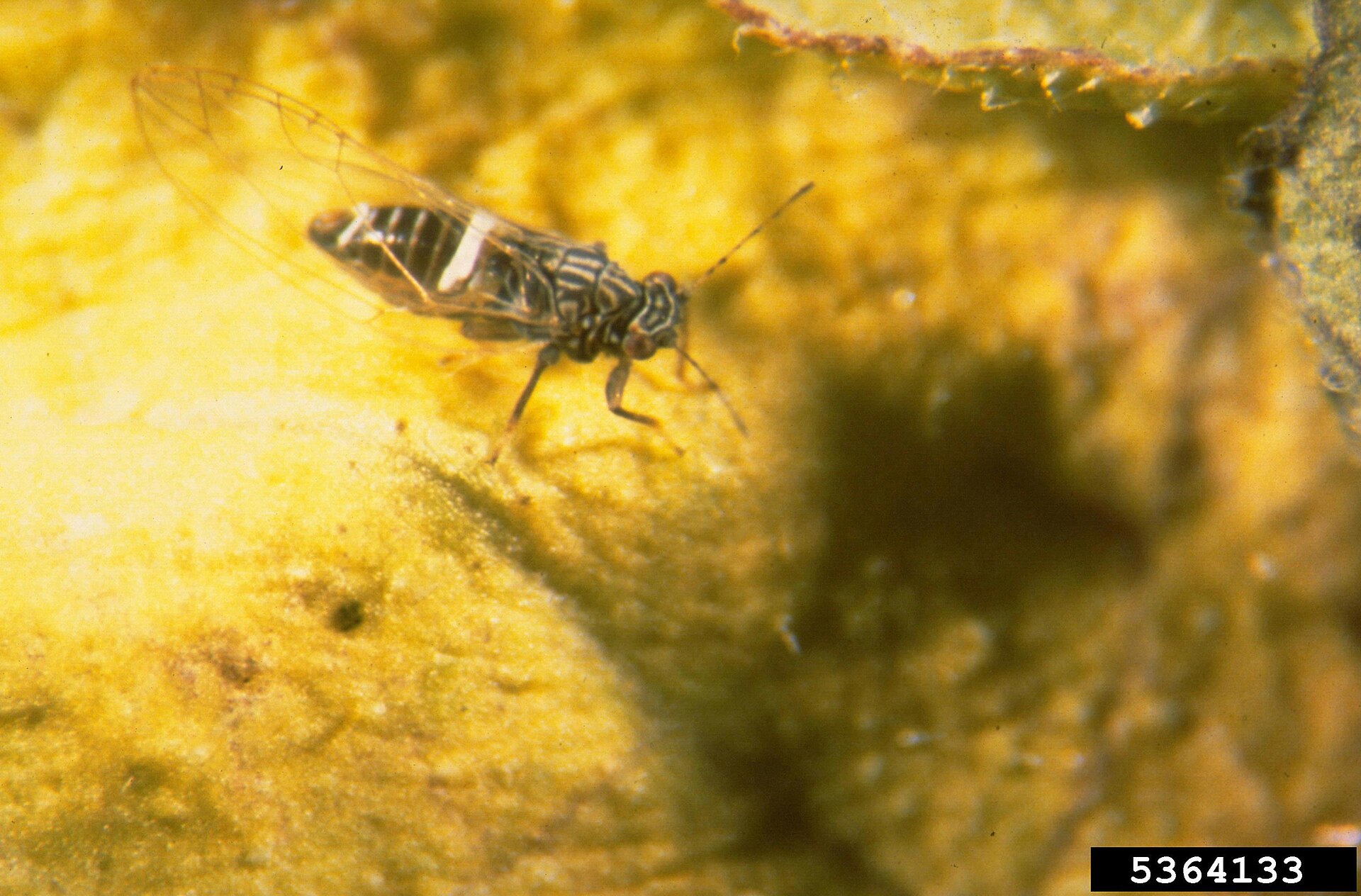
Photo: Potato psyllid (Bactericera cockerelli) on a potato leaf (illustrative). Whitney Cranshaw, Colorado State University, Bugwood.org / Wikimedia Commons, CC BY 3.0 nous
Résumé mondial sur la pomme de terre
Les cinq principales actualités, les prix, les alertes sanitaires et les événements. En semaine, le matin, sans publicité.
Références
- Oregon State University Extension PNW 633 — Potato psyllid vector of zebra chip disease in the Pacific Northwest (2014, revised 2017, reviewed 2023) — https://extension.oregonstate.edu/catalog/pnw-633-potato-psyllid-vector-zebra-chip-disease-pacific-northwest
- University of Florida IFAS EDIS PP320 — Candidatus Liberibacter solanacearum: An Emerging Pathogen Infecting Potato and Tomato (2015, reviewed 2019) — https://edis.ifas.ufl.edu/publication/PP320/pdf
- Utah State University Extension — Zebra Chip Disease of Potato (June 2015) — https://extension.usu.edu/pests/research/zebra-chip-disease
- American Journal of Potato Research — Zebra Chip Disease, Candidatus Liberibacter, and Potato Psyllid: A Global Threat (Munyaneza, 13 March 2015) — https://link.springer.com/article/10.1007/s12230-015-9448-6
- Annual Review of Entomology — Biology, Ecology, and Management of the Potato Psyllid and Zebra Chip Disease (Wenninger, Rashed, 25 January 2024) — https://www.annualreviews.org/content/journals/10.1146/annurev-ento-020123-014734
Lien dans ce matériel
- Pays
- Monde
- Aux technologies
- yellow sticky traps; insecticide rotation; psyllid monitoring
LIRE EGALEMENT
Globalement : La concentration de nitrate dans la sève du pétiole devrait passer de 1 200 à 1 600 ppm en début de floraison à environ 400 à 700 ppm en fin de grossissement.

À l'échelle mondiale : l'efficacité du Boscalid contre l'alternariose a chuté de 70-75 % à 30-40 % lors d'essais en plein champ en Suède.


